
- Product Building
- Founder Notes
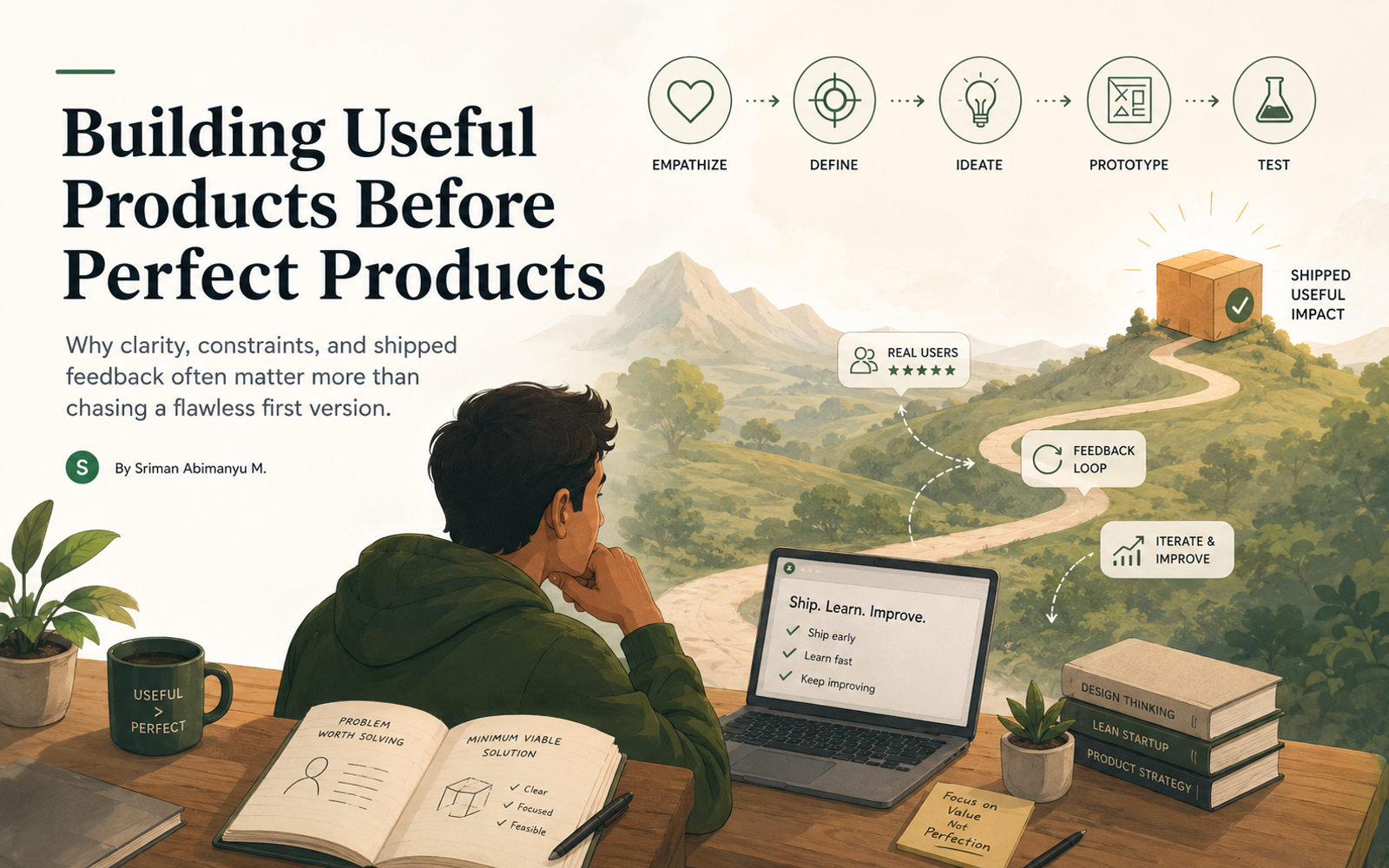
Building Useful Products Before Perfect Products
Why clarity, constraints, and shipped feedback often matter more than chasing a flawless first version
There is a version of every product that exists only inside the builder’s mind.
In that version, every screen is polished, every interaction feels natural, every edge case is handled, and every feature works exactly as imagined. The product looks complete even before the first real user touches it.
The problem is that this perfect version is usually built on assumptions.
We assume users will understand the workflow. We assume a feature is important because it sounds valuable. We assume the navigation is obvious because we designed it. We assume people will use the product in the same way we do.
Then the product reaches a real user.
They ignore the feature we spent weeks building. They struggle with a button we believed was self-explanatory. They ask for something that seemed too simple to include. Sometimes, they use the product in a completely different way from what we planned.
This is why I have started believing strongly in building useful products before perfect products.
Not careless products. Not incomplete products presented as finished solutions. But focused products that solve one meaningful problem clearly enough for people to use, experience, and respond to.
Perfect Is Often an Unverified Assumption
Perfection feels productive because it gives us something measurable to chase.
We can improve spacing, add animations, redesign a dashboard, introduce more settings, refine the architecture, and continue adding features. Every improvement feels like progress.
But product progress is not always the same as development progress.
A technically impressive application can still be confusing. A beautifully designed interface can still solve the wrong problem. A product with twenty features can still be less useful than one with three well-chosen features.
Until users interact with the product, much of what we call quality is still a hypothesis.
This is where product execution must work together with design thinking.
Design thinking is not simply about creating visually appealing interfaces. It is about understanding people, identifying the actual problem, exploring possible solutions, building something testable, and learning from how people respond.
The process is not:
Think → Build → Perfect → Launch
It is closer to:
Understand → Define → Build → Observe → Learn → Improve
The difference is important.
In the first approach, learning happens after most of the investment has already been made. In the second, learning becomes part of the building process.
Start With Clarity, Not Features
When a product idea begins, it is easy to start listing features.
Login, dashboard, reports, notifications, artificial intelligence, analytics, exports, integrations, customisation, role management, automation—the list can grow quickly.
But a feature list is not product clarity.
Clarity begins with a few more difficult questions:
Who is this product for?
What problem are they facing today?
How are they currently solving it?
What is frustrating, expensive, slow, or unreliable about the existing process?
What is the smallest useful outcome the product can deliver?
For example, imagine building a platform for training programmes.
It is tempting to begin by imagining certificates, quizzes, student profiles, analytics, artificial intelligence reports, project submissions, trainer discovery, and public portfolios.
All of these may eventually be valuable.
But the first real problem might simply be this:
“The programme coordinator cannot reliably track attendance across multiple sessions and generate a clear report.”
That problem gives the product direction.
The first useful version may only need session creation, student verification, attendance submission, duplicate prevention, and a downloadable report.
It may not look like the final vision. But it solves something real.
Once people use it, better questions emerge.
Do administrators need session-wise or cumulative reports?
Are students entering incorrect information?
Does location validation help, or does it create unnecessary friction?
Who reviews questionable entries?
Should attendance determine certificate eligibility?
These questions are more valuable than assumptions because they come from actual usage.
Constraints Are Not Always the Enemy
Builders often view constraints as limitations.
We want more time, a larger team, a bigger budget, complete requirements, better infrastructure, and the freedom to include every good idea.
But constraints can improve a product.
A deadline forces us to identify what is essential.
A limited budget prevents us from adding technology without a clear reason.
A small team encourages simpler architecture.
A narrow target audience helps us write clearer workflows.
A feature limit forces prioritisation.
When everything is possible, it becomes difficult to decide what matters. Constraints create boundaries, and boundaries make decisions easier.
The question changes from:
“What else can we add?”
to:
“What must work for this product to be useful?”
That is a much stronger product question.
Of course, constraints should not be used as an excuse for poor security, broken accessibility, unreliable data handling, or unsafe workflows. This is especially important in products involving healthcare, payments, personal information, or business-critical operations.
“Useful before perfect” does not mean “ship without responsibility.”
It means separating essential quality from optional polish.
Data integrity may be essential. An elaborate animation may not be.
A clear error message may be essential. Ten dashboard themes may not be.
A reliable workflow may be essential. Advanced customisation may come later.
Good execution is not about reducing quality. It is about applying quality where it matters first.
A Shipped Product Creates Better Conversations
Ideas attract opinions.
Working products attract evidence.
When we explain an idea, people usually respond politely. They say it sounds useful. They suggest features. They compare it with products they already know.
But when they use it, the feedback changes.
They say:
“I did not understand what to do here.”
“This step takes too long.”
“Can this information be reused instead of entered again?”
“I only need this report.”
“This is the feature I would pay for.”
That feedback is specific because the product gives people something concrete to react to.
This is one of the biggest advantages of shipping a focused version early. It converts vague discussions into observable behaviour.
A user may tell us that a feature is important and still never use it.
They may say the interface looks good but abandon the workflow halfway through.
They may request advanced analytics but repeatedly depend on a simple CSV export.
Product decisions should consider what users say, but also what they actually do.
Shipped feedback gives us both.
The First Version Is a Learning System
A first version should not be treated only as a smaller version of the final product.
It should be designed as a learning system.
Its purpose is to test the most important assumptions behind the product.
Do users experience the problem strongly enough?
Can they understand the proposed solution?
Does the workflow fit into their existing behaviour?
Will they return to use it again?
Does the product save meaningful time, reduce effort, improve accuracy, or create a result they value?
These questions matter more than whether the first release contains every planned feature.
This is also why analytics alone are not enough. Numbers can show where users stop, what they click, and how frequently they return. But conversations help us understand why.
The most useful learning often comes from a combination of:
- Watching someone use the product.
- Listening to the questions they ask.
- Reviewing the mistakes they make.
- Understanding the workarounds they create.
- Identifying the parts they repeatedly depend on.
Sometimes, the workaround is more valuable than the original feature.
It may reveal that users are trying to solve a related but more urgent problem. A good product team does not defend the original design blindly. It pays attention.
Product Execution Is the Discipline of Choosing
Ideas are exciting because they are unlimited.
Execution is difficult because it requires choices.
What will we build now?
What will we postpone?
What will we deliberately not build?
What level of quality is required before release?
What evidence would convince us to continue, change direction, or stop?
Strong product execution is not measured by how many features are completed. It is measured by how effectively the team converts a problem into a useful outcome.
That requires design, development, business thinking, and user understanding to remain connected.
Design should not happen separately and then be handed over.
Development should not begin with a feature list that has never been challenged.
Business decisions should not depend only on what sounds easy to sell.
Each function must contribute to the same question:
“Are we solving the right problem in a way people can realistically use?”
This alignment is more important than having the perfect process, the perfect framework, or the perfect technology stack.
Useful Does Not Mean Ugly
There is sometimes a false choice between usefulness and good design.
A product does not need to look unfinished simply because it is an early version.
Clarity itself is a form of design.
A focused product can have clean typography, predictable navigation, clear states, understandable labels, and a consistent visual language without spending months on visual perfection.
Good early-stage design reduces cognitive load.
It helps users recognise what the product does, understand what is expected, and complete the main task without unnecessary confusion.
The goal is not to impress users with every screen.
The goal is to help them succeed.
Polish should support the product’s purpose. It should not hide the absence of one.
Build the Core. Learn From Reality. Then Expand.
Many products fail not because the builders lacked skill, but because they committed too deeply to an untested version of the idea.
They built for scale before finding regular users.
They created complex permissions before understanding actual roles.
They added integrations before validating the central workflow.
They spent months preparing for scenarios that never occurred.
A better approach is to build the core carefully, put it in front of the right people, and let reality guide the next version.
This does not eliminate planning. It improves planning.
Roadmaps become connected to evidence.
Priorities become connected to user behaviour.
Technical decisions become connected to actual load and complexity.
Design improvements become connected to observed confusion.
The product becomes stronger because each version is informed by the previous one.
The Real Goal Is Progress With Direction
Perfection is not a bad ambition.
The problem begins when the pursuit of perfection delays learning, hides uncertainty, or prevents a useful solution from reaching the people who need it.
The first version does not need to prove that the entire vision is correct.
It needs to prove that the next step is worth taking.
A useful product creates value.
A shipped product creates feedback.
A clear product creates understanding.
A responsibly built product creates trust.
When these foundations are present, polish becomes meaningful. Features become intentional. Growth becomes more sustainable.
Build the version that solves the problem clearly.
Let people use it.
Observe where it succeeds and where it fails.
Then improve it with purpose.
Because the best products are rarely born perfect.
They become better by being useful first.